
Articles on promotion, new roles and leadership assessment.
Analysis of promotion, executive transition, assessment, and the operating conditions that make the same leader effective in one role and costly in another.
Book a call
Why strong performers struggle after promotion
The habits that get someone promoted are not the habits that run a team. What changes when a strong performer becomes a manager? What should you watch in the first months?
Read the analysis
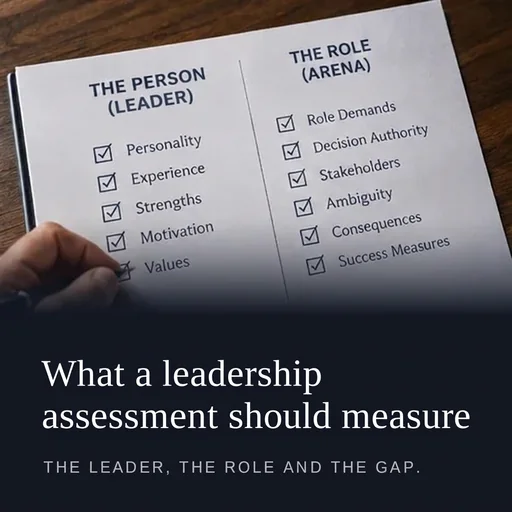
What a leadership assessment should measure
A trait score on its own predicts little about performance. A useful assessment measures the leader, the conditions of the role, and the gap between them, and ends with something to test.
Read the analysis

The first 90 days after an executive promotion
Ninety days is long enough to test whether an executive and a new role fit. Map what changed, run a few bounded tests, protect the path for bad news, and review the role as well as the person.
Read the analysis

Why leadership strengths reverse in a new environment
A strength is a tendency that pays off under particular conditions. Change the threat or the stability of a role, and the same tendency can start to cost.
Read the analysis

Frontline supervisor development in Kansas City
The Kansas City metro has about 43,000 first-line supervisor jobs in seven common occupations. What changes when a crew member becomes the supervisor, and which moments to rehearse.
Read the analysis

Executive coaching or executive assessment?
Coaching works when the target is clear. Feedback without a clear target often makes performance worse. When the problem is unclear, assess first.
Read the analysis